
Free IQ Test
- No sign-up
- No email
- No paywall at the end
A real IQ test built on published cognitive-ability research. Get your score, percentile, and cognitive breakdown in about ten minutes.
No email, no paywall, no “premium report.” Your data is safe in your browser.
Try a question right now
Here is one of the sixteen questions, exactly as it appears in the test. It is live — pick an answer.
That is the whole format: pattern puzzles, no trivia, nothing to memorize, nothing to study for.
What the test measures
This is a reasoning test, not a trivia quiz. There is nothing to look up and nothing to recall, so it measures how you think, not what you happen to know. The sixteen questions sample four kinds of reasoning:

You know the routine.
You answer questions for twenty, thirty, forty minutes. You reach the results page. A progress bar crawls to 100%. And then: “Enter your email to see your score.” Or worse, “Unlock your full report for $29.99.”
That is not a test. That is bait with a toll booth at the end. We built the opposite.
We would rather you see your score, trust the site, and share it than trap your result behind a form. That is the entire business model: be the free one people actually recommend.
What your score means
IQ scores are built to centre on 100. Most people land between 85 and 115, and the further a score sits from the middle, the rarer it is. Drag the marker across the scale to see where any score lands.
Want to know about a specific number? Seethe full IQ scaleor jump to a common one:is 120 good?is 130 good?is 140 good?
How accurate is an online IQ test?
Straight answer: a short online test is a screener, not a clinical diagnosis. A proctored test administered by a psychologist is still the gold standard, and no ten-minute test replaces it.
What makes this one more than a quiz is where the questions come from. The matrix items are generated from the Sandia Matrices, an openly licensed research item set whose scores correlate r = .69 with Raven's Progressive Matrices — about .93 once you correct for the reliability of the two tests. The rotation items come from a published, validated stimulus set. These are not puzzles we invented on a weekend.
A quick primer on IQ
What IQ actually is
IQ, or intelligence quotient, is a score that compares your reasoning ability to the general population on a scale centred at 100. It is not a measure of worth, creativity, or character, and it never was meant to be.What does IQ stand for?
Where the scale comes from
Modern tests place scores on a bell curve with an average of 100 and a standard deviation of 15, so about two-thirds of people fall between 85 and 115.More on the average.
Can you raise it?
Somewhat. Education and environment nudge scores, but brain-training apps mostly make you better at the app, not smarter.Can you increase your IQ?
Famous IQs
Explore all celebrity IQ estimatesEver wonder where the smartest, or most talked-about, people would land? We collect the estimates and, unlike most sites, we tell you honestly which numbers are real and which are guesses.
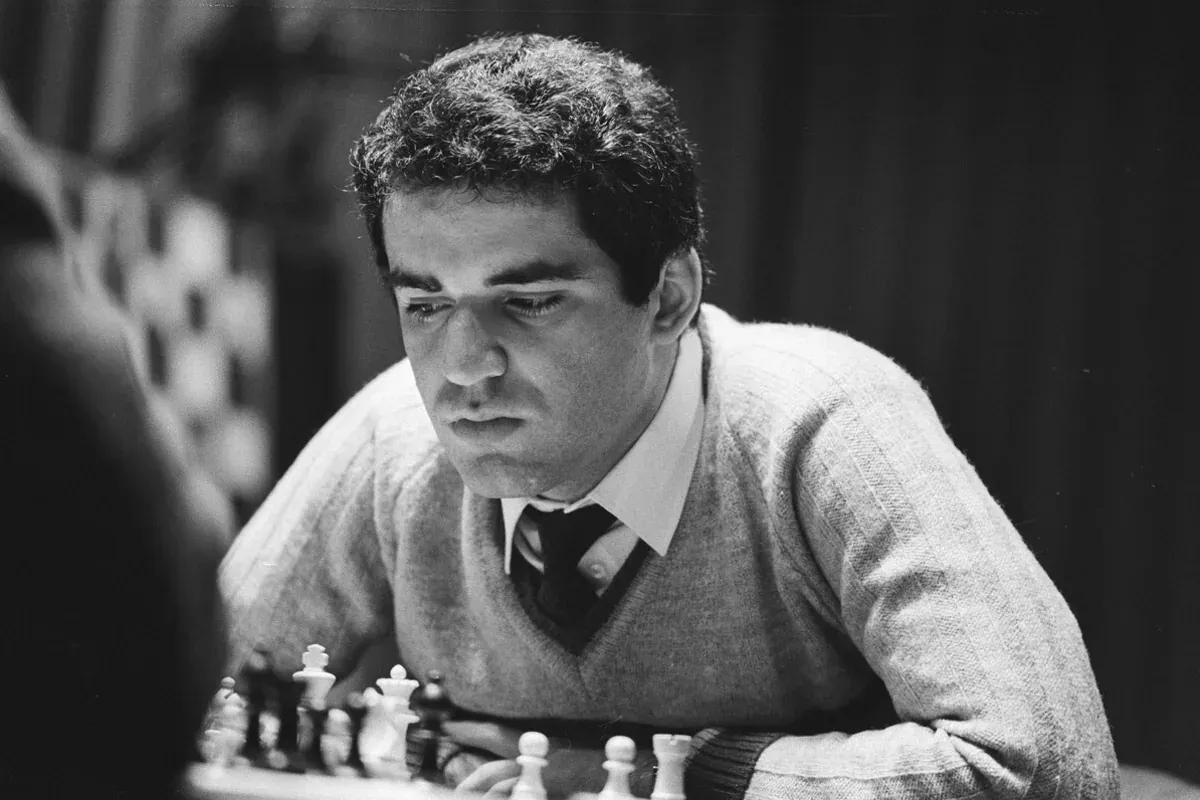 Garry KasparovChess world champion, 1985–2000135VerifiedRead full IQ profile
 Marilyn vos SavantColumnist, former Guinness record holder228*ReportedRead full IQ profile
 Richard FeynmanPhysicist, Nobel laureate125ReportedRead full IQ profile
 Elon MuskCEO of Tesla and SpaceX150–155EstimatedRead full IQ profile
 Albert EinsteinTheoretical physicist, Nobel laureate160SpeculativeRead full IQ profile
 Stephen HawkingTheoretical physicist, cosmologist160SpeculativeRead full IQ profile
* Marilyn vos Savant's 228 comes from a childhood test scored as a ratio of mental to chronological age, a method modern tests abandoned. On today's scale the equivalent figure is lower — which is exactly the sort of detail most lists leave out.
Explore all celebrity IQ estimatesWhat you get at the end
No wall, no wait. The moment you answer the last question, all of this is on screen:
- Your IQ score on the standard scale
- Your percentile and how rare it is
- Where you land on the bell curve
- A breakdown across the four reasoning types
- A share image you can post or save
Frequently asked questions
Is this IQ test really free?
Yes, completely. Your score, percentile, breakdown, and share image are all free, with no sign-up and no payment at any point. That is the whole idea. See how we compare.
What does IQ stand for?
Intelligence quotient. It is a standardised score comparing your reasoning ability to the general population, centred on 100.
How accurate is this test?
It is a research-backed screener built on published, open-licensed items, so it gives a reliable estimate in about ten minutes. It is not a clinical assessment, which needs a licensed psychologist. Full accuracy breakdown.
How long does it take?
Sixteen questions, usually about ten minutes. There is no time limit, so you will not be rushed.
Do I need an account or email?
No. You go straight from the last question to your score. Nothing is gated.
What is a good IQ score?
Anything above 115 is above average, 130 and up is gifted territory, and 100 is exactly average. What is a good IQ?
What is the average IQ score?
100, by design. Most people score between 85 and 115. More on average IQ.
What do the questions measure?
Four kinds of reasoning: matrix patterns, number and letter series, verbal relationships, and 3D rotation. No general knowledge, no vocabulary you had to study.
Where do the questions come from?
Published, openly licensed cognitive-ability research — the Sandia Matrices for matrix reasoning and the Ganis & Kievit stimulus set for mental rotation, with series and verbal items built to the same specifications. Methodology.
How is it scored?
Your answers are compared against a reference distribution and mapped to the standard scale (mean 100, standard deviation 15). How scoring works.
Can I retake it?
Yes. Scores can wobble a few points between attempts, which is normal for any test.
Can I take it on my phone?
Yes, it works on any device. No app to install.
Can IQ change over time?
It is fairly stable in adults, but it can shift with age, education, and environment. It is not fixed for life.
How does this compare to an official test like the WAIS?
The WAIS is a longer, proctored clinical test and remains more precise. This is a fast, free screener built on validated items, meant to give you a solid estimate, not a diagnosis.